Booking choice: The Montjuïc e-bike tour, from $40 per person. Check dates Tour details
Montjuïc is the broad, flat-topped hill southwest of the old city, 184.8 m high, with an almost sheer side dropping to the port. Wikipedia calls it the birthplace of Barcelona. The 1929 International Exposition and the 1992 Olympics left most of what you visit today, and the slopes between them are gardens.
The hill is big and the sights are spread out. Pick a cluster, use the funicular, the cable car or bus 150 for the climbs, and walk the rest downhill.
The quick answer
Start low at the Teatre Grec and its rose gardens (free), climb to the Fundació Joan Miró, then take the cable car to Montjuïc Castle. On a full day add the MNAC, Poble Espanyol and the Olympic Ring, and finish at the Magic Fountain, which plays from 20:00 on Thursday, Friday and Saturday in winter.
What is there to do on Montjuïc?
Two art museums (the Fundació Joan Miró and the MNAC), the Teatre Grec and its gardens, the Magic Fountain, the Poble Espanyol, Montjuïc Castle and the Olympic Ring, linked by the funicular, the cable car and bus 150.
Here is the hill at a glance, with the official prices we read on 23 November 2026. Several sights are free, and two museums have free slots worth planning around.
| Sight | What it is | Entry |
|---|---|---|
| Teatre Grec and gardens | 1929 open-air theatre in a quarry, rose terraces | Free, daily |
| Fundació Joan Miró | Miró's art in Sert's building, above the Teatre Grec gardens | €17 online, €18 on site |
| MNAC | Catalan art in the Palau Nacional | €12; free Saturdays from 15:00 |
| Magic Fountain | Light, water and music shows | Free |
| Poble Espanyol | 1929 village of Spanish architecture | Ticket, from $12 |
| Montjuïc Castle | Fortress on the summit, views all round | €12; free under 16 |
| Olympic Ring | Stadium and 1992 venues | Free to walk around |
| Montjuïc Cable Car | Cabins from Parc de Montjuïc to the castle | €19 return at the office |
Most visitors only see the top or the bottom of the hill. The middle, where the Teatre Grec and the Miró sit, is the calm part, and it links the two.
Is the Teatre Grec worth a stop on Montjuïc?
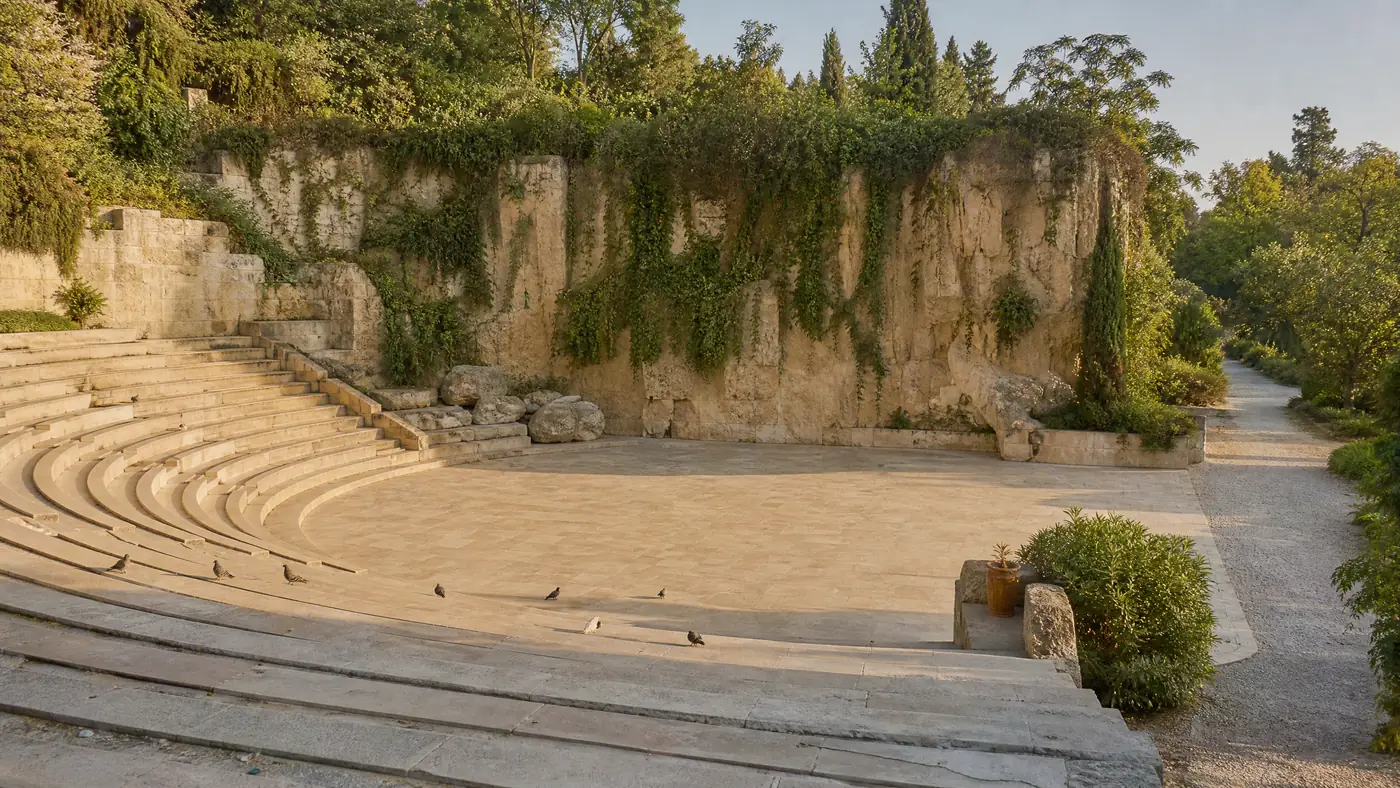
Yes, and it costs nothing. The 1929 theatre and its rose gardens are a public park, open daily from 08:00 (until 19:00 in winter, 21:00 from April to October).
Come in from Passeig de Santa Madrona, up the stone stairway on either side of the wall. The stone tiers curve under the old quarry face, and the gardens above climb in terraces of roses, pergolas and ponds. In summer the stage hosts the Grec Festival; the rest of the year you mostly share it with joggers and people reading in the shade.
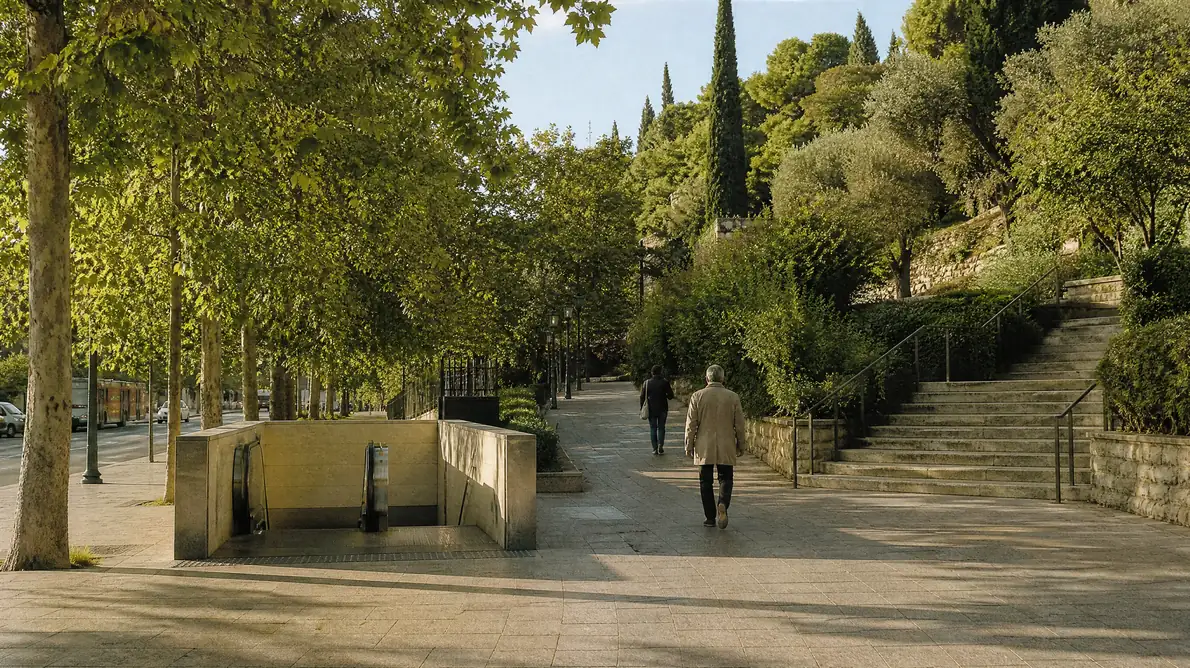
The gardens are also the easy way up. They bridge 44 metres between Passeig de Santa Madrona and the Plaça del Solstici, where the Fundació Joan Miró stands, so a visit to the theatre doubles as the first climb of the day. No pets, and access can be limited during rehearsals and shows.
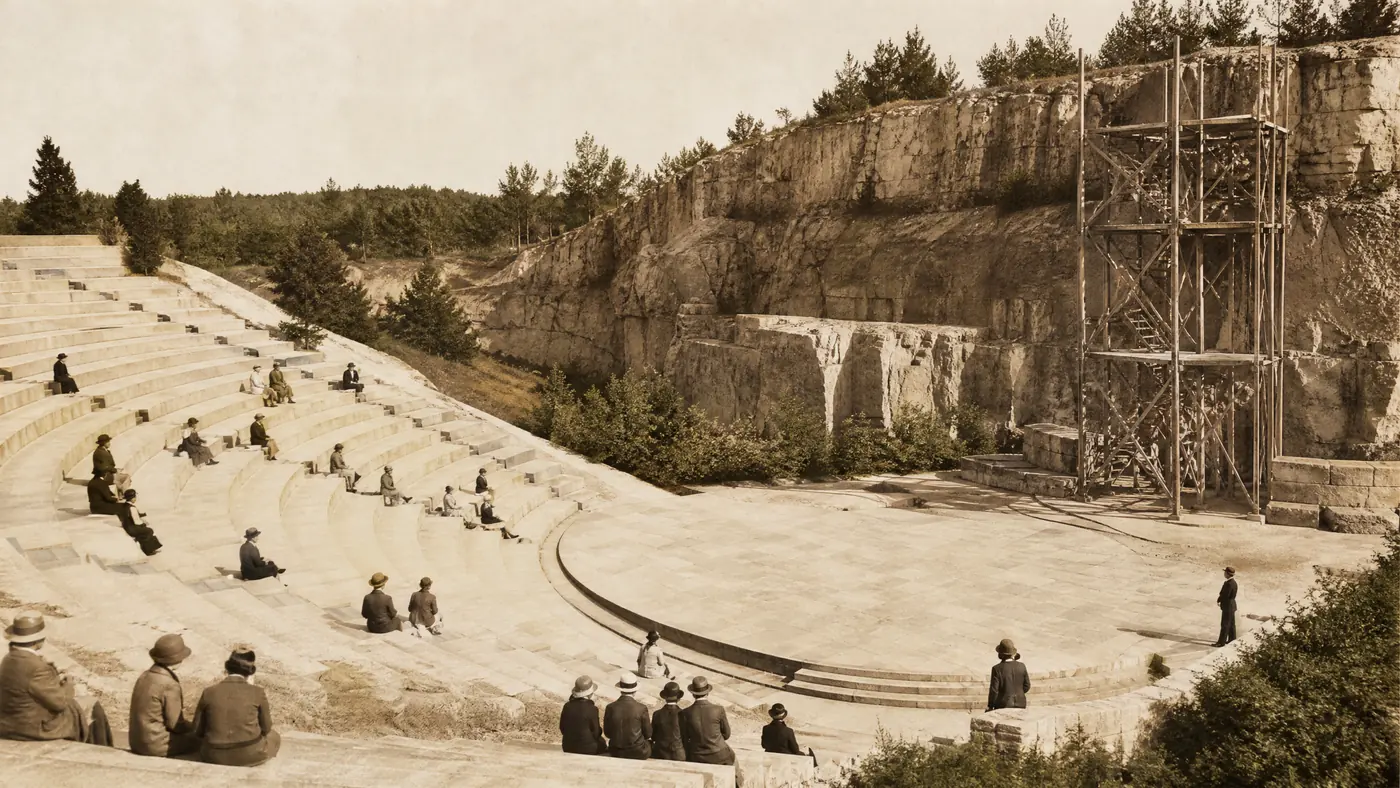
Our Teatre Grec visitor guide covers what you see, and the history page tells the story of the stage.
What can you see at the Fundació Joan Miró?
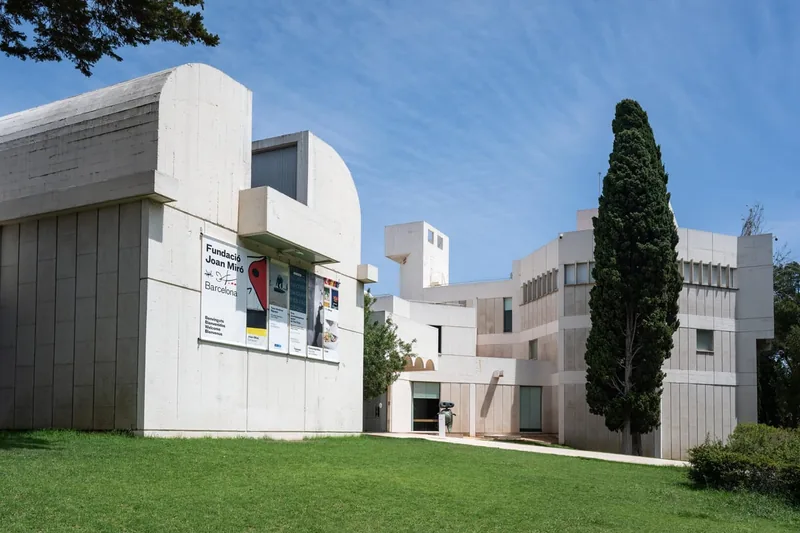
The most complete collection of Joan Miró's art, in a white building by Josep Lluís Sert at the top of the Teatre Grec gardens. Tickets cost €17 online or €18 on site; under 12s go free.
Miró described the building, in the words the museum quotes, as "an open, radiant architecture focused on the vision of art and the contemplation of nature: a garden for everybody." The collection follows the stages of his career and the media he worked in, and there are temporary shows of contemporary artists too. A restaurant and café are inside.
| Fundació Joan Miró | Details |
|---|---|
| Winter (1 November to 31 March) | Tuesday to Sunday, 10:00 to 19:00 |
| Summer (1 April to 31 October) | Tuesday to Saturday, 10:00 to 20:00; Sunday 10:00 to 19:00 |
| Closed | Mondays (a few holiday Mondays excepted); 1 January, 25 and 26 December |
| General ticket | €17 online, €18 on site |
| Concessions | €11 online, €12 on site (students 13 to 25, over 65s) |
| Free | Children under 12 with an adult, among others |
| Getting there | Bus 55 or 150 to Parc de Montjuïc; or up through the Teatre Grec gardens |
Entry to the rooms ends 30 minutes before closing. Food and drink are only allowed in the café.
A dated skip-the-line ticket for the Fundació Joan Miró, with the temporary exhibitions included. Free cancellation up to 24 hours before.
Explore the Fundació Joan Miró ticket Tour detailsWhat is the MNAC on Montjuïc?
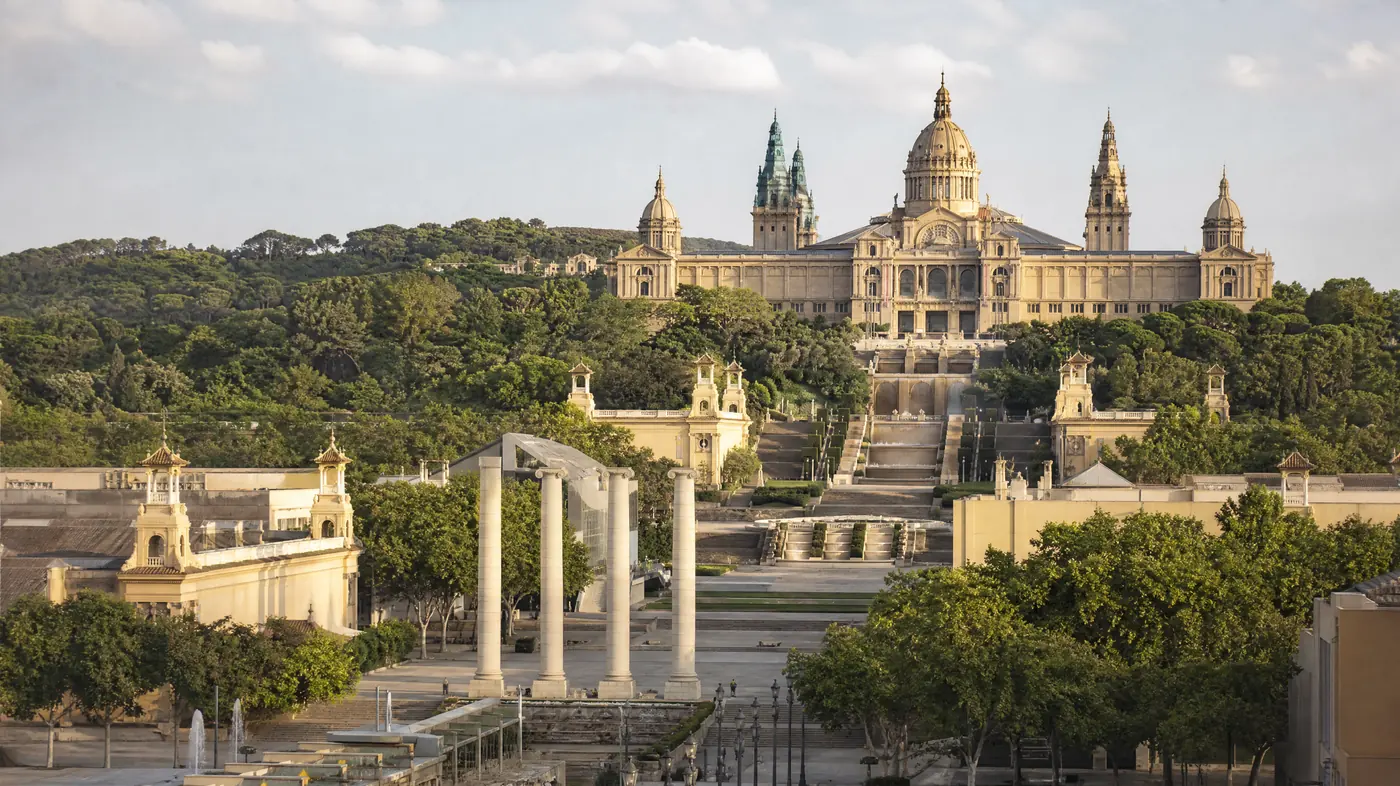
The Museu Nacional d'Art de Catalunya, in the domed Palau Nacional built for the 1929 Exposition. General admission is €12, and it is free on Saturdays from 15:00 and on the first Sunday of the month.
The Palau Nacional was the main building of the 1929 fair, built between 1926 and 1929 with a large elliptical dome and 32,000 m2 of floor. Wikipedia says it has housed the MNAC since 1934, with a showcase of Catalan painting and sculpture. The wide stairs below it run down past cascades to the Magic Fountain and Plaça d'Espanya.
- Winter hours (October to April): Tuesday to Saturday 10:00 to 18:00; Sundays and holidays 10:00 to 15:00.
- Summer hours (May to September): Tuesday to Saturday 10:00 to 20:00; Sundays 10:00 to 15:00.
- Closed: Mondays except holidays, and 1 January, 1 May and 25 December.
- Free slots: Saturdays from 15:00 and the first Sunday of each month, with an online reservation.
The ticket normally includes the Rooftop Viewpoint, but on 23 November 2026 the museum listed it as temporarily closed for improvement works. The terrace in front of the palace is free and has one of the best views over Plaça d'Espanya anyway.
The cable car, castle and Magic Fountain tour passes the Fundació Joan Miró and the MNAC on its way down the hill, with tapas before the fountain show.
Check dates for the cable car, castle and Magic Fountain tourWhen does the Magic Fountain play?
From 1 November to 31 March the shows run on Thursday, Friday and Saturday from 20:00 to 21:00, with music and colour shows starting at 20:00 and 20:30. Watching is free.
Carles Buïgas designed the fountain for the 1929 Exposition; over 3,000 workers built it, and the first show took place on 19 May 1929, the day before the fair opened. Wikipedia counts 3,620 jets. The fountain was badly damaged in the Civil War and only ran again in 1955, music joined the light in the 1980s, and it was fully restored for the 1992 Olympics.
The schedule above is the winter season on the City Council's show-times page, updated on 16 November 2026; the summer season runs more evenings. Arrive a little early and stand on the steps below the MNAC, where the whole display lines up with the palace behind it.
It works as the last stop of a Montjuïc day. Both the Montjuïc walk with wine and the cable car, castle and Magic Fountain tour end there.
Is Poble Espanyol worth visiting?
Yes, for an easy hour or two of Spanish architecture in one walled village, built for the 1929 Exposition: 117 buildings, about 20 crafts workshops and the Fran Daurel Museum.
Ramon Reventós, the architect of the Teatre Grec, designed it with Francesc Folguera, with the artists Miquel Utrillo and Xavier Nogués as advisers. Wikipedia describes a village of regional quarters around a main square, entered through a copy of the walls of Ávila.
- What the ticket covers: the village, the Fran Daurel Museum (Picasso, Dalí, Miró and more), the audiovisual shows Feeling Spain and Fiesta!, an exhibition on how the village was built, and a children's area with giant slides.
- Opening times: Monday 10:00 to 20:00, Tuesday to Sunday 10:00 to midnight.
- Workshops and shops: 10:00 to 18:00 from November to February, 10:00 to 19:00 from March to October.
The ticket office closes an hour earlier. It sits on the western side of the hill, a short walk up from the Magic Fountain, so pair the two on the same afternoon.
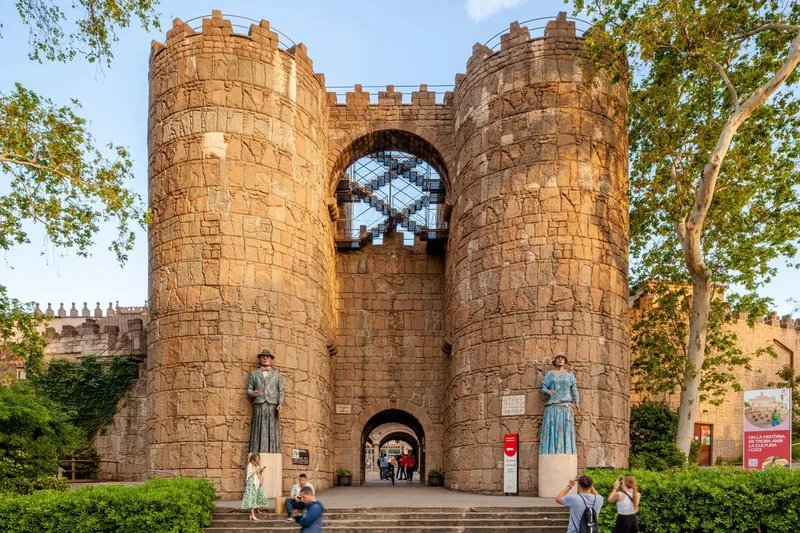
Entry to Poble Espanyol with the Fran Daurel Museum, the audiovisual shows and the panoramic views. Built for the same 1929 fair as the Teatre Grec.
Explore the Poble Espanyol ticket Tour detailsIs Montjuïc Castle worth it, and what is the Olympic Ring?
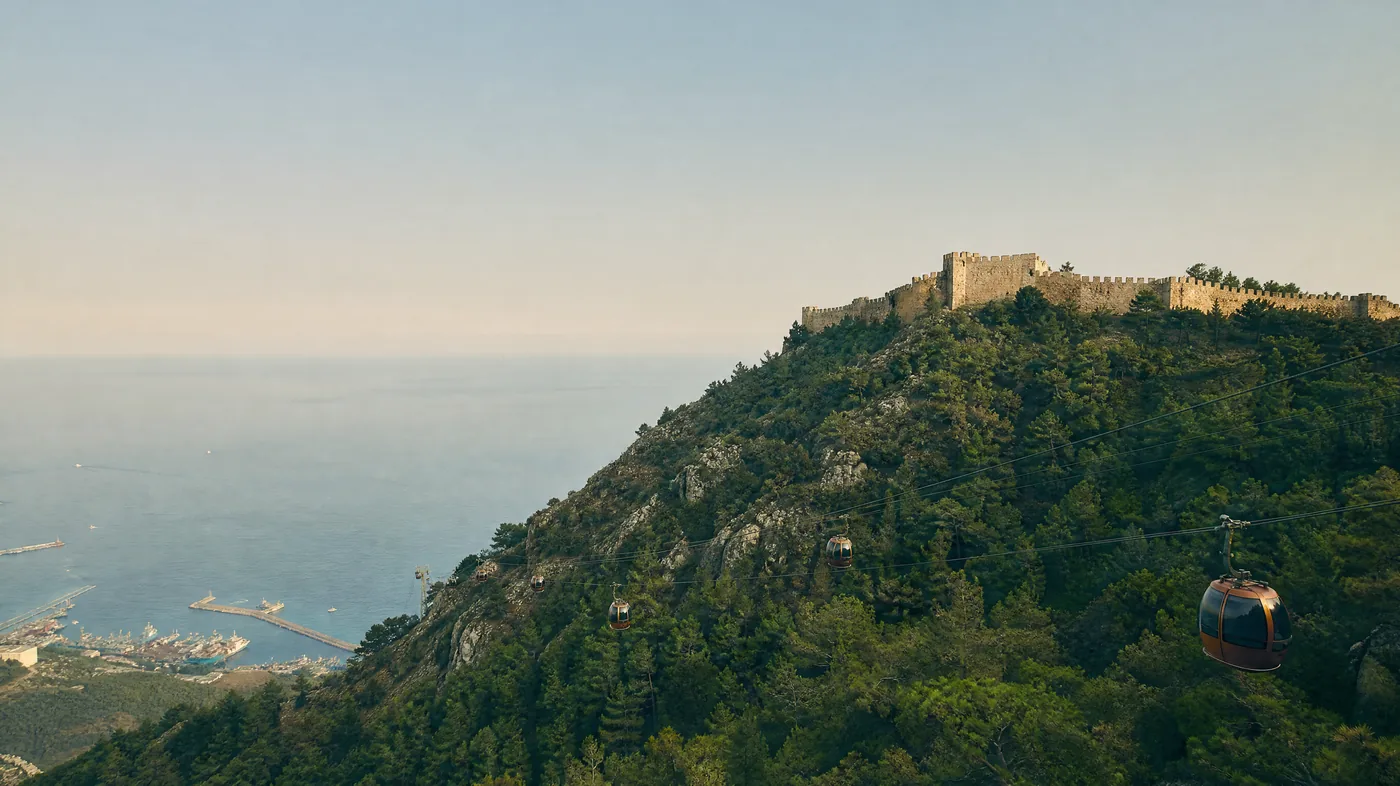
The castle is the summit: a 17th-century fortress with views over the city and the port, €12 to enter and free under 16. The Olympic Ring is the 1992 Games park around the stadium, free to walk.
The fortress largely dates from the 17th century, with 18th-century additions. Its history is heavy. Wikipedia notes the garrison shelled the city in 1842, the castle served as a political prison, and Lluís Companys, former president of the Generalitat, was executed there in 1940. It also played a part in science: in 1794 the French astronomer Méchain measured from the fortress for the survey that defined the metre.
| Montjuïc Castle | Details |
|---|---|
| November to February | 10:00 to 18:00 (box office until 17:30) |
| March to October | 10:00 to 20:00 (box office until 19:30) |
| Tickets | €12 general, €8 reduced; €16 with a guided tour |
| Free | Under 16s, Sundays from 15:00, the first Sunday of each month |
| English guided tour | Weekends and holidays at 13:00 |
| Getting up | Cable car; bus 150; or a 20 to 25 minute uphill walk from the funicular |
The Olympic Ring sits on the western ridge. The stadium was finished for 1929, refurbished as the Estadi Olímpic Lluís Companys and used for the opening and closing ceremonies of 1992. Around it stand the Palau Sant Jordi arena, the Bernat Picornell pools, Santiago Calatrava's telecommunications tower, and, on the city side, the Montjuïc municipal pool whose diving boards face the skyline.
Between them, the gardens: Joan Brossa and Mossèn Cinto Verdaguer on the way up to the castle, Laribal beside the Teatre Grec, and the Mirador de l'Alcalde viewpoint, a stop on the cable car's way down.
The Montjuïc e-bike tour rides up to the castle and the Olympic Stadium without the climb, in a small group of 2 to 8 with a local guide.
Check dates for the Montjuïc e-bike tourHow do you plan a half day or a full day on Montjuïc?
For half a day, walk up through the Teatre Grec gardens to the Miró, ride the cable car to the castle and come down by funicular. For a full day, add the MNAC, the Olympic Ring and Poble Espanyol, and end at the Magic Fountain.
Half day, from the bottom:
- Metro to Poble Sec (L3) and walk to Passeig de Santa Madrona and the Teatre Grec gardens.
- Climb the rose terraces to the Plaça del Solstici and the Fundació Joan Miró.
- Continue to the Parc de Montjuïc station and ride the cable car to the castle.
- Ride back down, stopping at the Mirador de l'Alcalde if you like, then take the funicular to Paral·lel.
Full day: do the morning the other way round, castle first while the light is clear. After lunch walk to the Olympic Ring, drop down to the MNAC, spend late afternoon in Poble Espanyol, and finish at the Magic Fountain if it is a show night. Our cable car and funicular guide has the hours and prices for the rides.
Or let someone else plan it:
| Tour | On Montjuïc | Length | From |
|---|---|---|---|
| Montjuïc walk with wine | Gardens, viewpoint wine, castle outside, Teatre Grec, Magic Fountain | 3 hours | $26 per person |
| Montjuïc e-bike tour | Castle, Olympic Stadium, MNAC, viewpoints | 2.5 hours | $40 per person |
| Cable car, castle and Magic Fountain | Cable car, castle entry, Olympic Stadium, tapas, fountain show | 5.5 hours | $84 per person |
| Fundació Joan Miró ticket | The museum above the Teatre Grec gardens | Day ticket | $20 per person |
| Poble Espanyol ticket | The 1929 village and its museum | Day ticket | $12 per person |
The castle entry is not part of the walk or the e-bike tour; the cable car, castle and Magic Fountain tour includes it. Wear proper shoes either way, as the paths are steep in places.

Two and a half hours on an e-bike from Ciutadella to Montjuïc: the castle, the Olympic Stadium and the MNAC, with an extra hour of e-bike rental after the tour.
Explore the Montjuïc e-bike tour Tour detailsFrequently asked questions
What is Montjuïc famous for?
The 1929 International Exposition and the 1992 Olympics, which left the Palau Nacional (now the MNAC), the Magic Fountain, Poble Espanyol, the Teatre Grec and the Olympic Ring. The castle crowns the top.
Is Montjuïc free to visit?
The park, the gardens, the Teatre Grec, the Olympic Ring and the Magic Fountain shows are free. The museums, Poble Espanyol, the castle and the cable car charge entry.
How much time do you need on Montjuïc?
Half a day covers the Teatre Grec, the Miró and the castle by cable car. A full day adds the MNAC, the Olympic Ring, Poble Espanyol and an evening at the Magic Fountain.
How do you get to the top of Montjuïc?
Take the funicular from Paral·lel metro station to Parc de Montjuïc, then the cable car or bus 150 to the castle. On foot it is a steady uphill walk of 20 to 25 minutes from the funicular.
Ready to book
Choose your tour
Free cancellation up to 24 hours before on every option. Prices are from-prices in USD and move with the season.
Montjuïc E-Bike Tour with the Castle and Views
The whole mountain without the climb
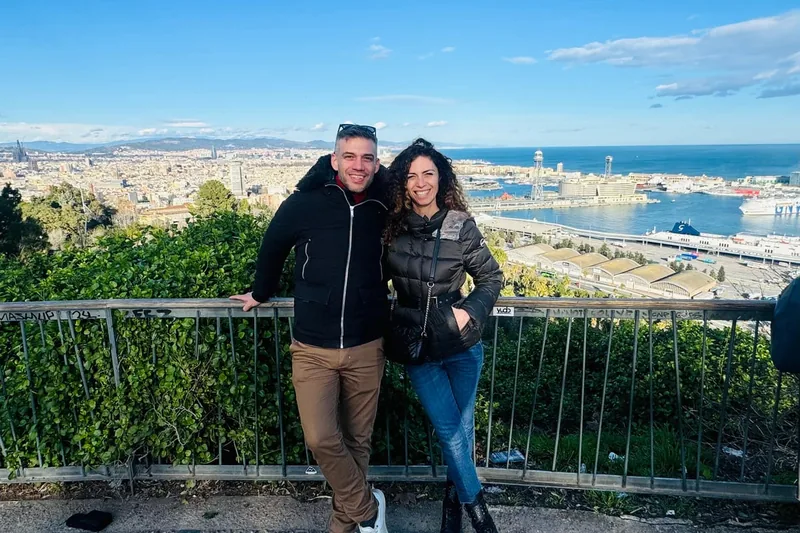
Montjuïc Walking Tour with a Glass of Wine
- Local guide
- Glass of wine at a viewpoint
- The Teatre Grec on the route
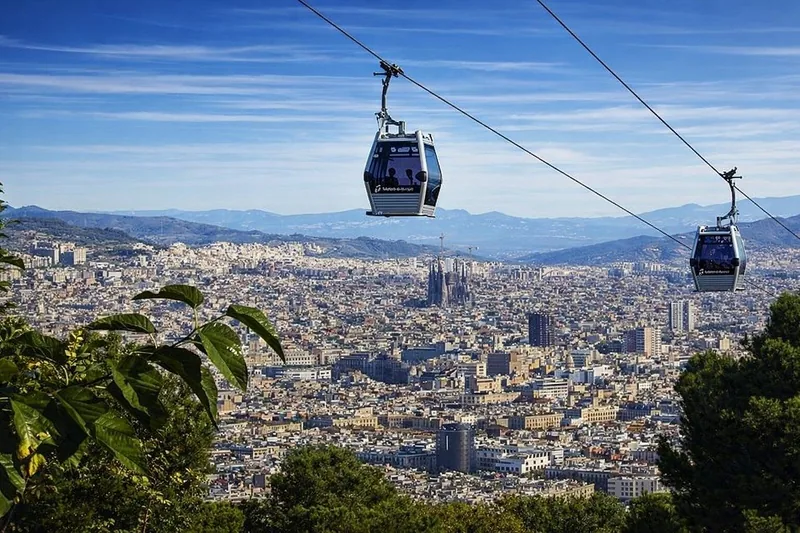
Cable Car, Montjuïc Castle and Magic Fountain
An afternoon into evening on the mountain